
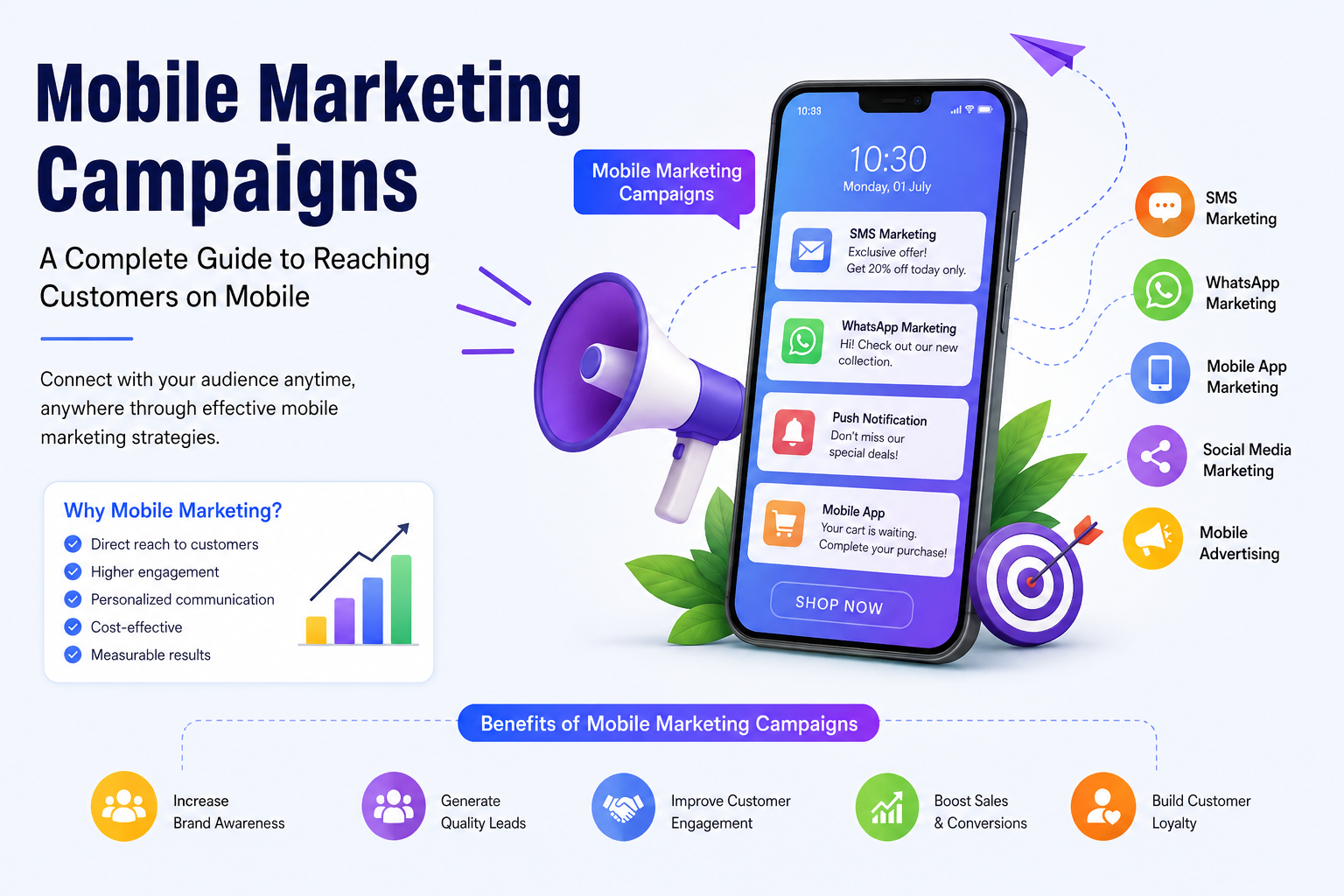
 In today’s fast-moving digital world, smartphones have become an essential part of everyday life. People use mobile devices to communicate, shop online, watch videos, browse social media, search for information, make payments, and interact with brands. Because customers spend so much time on their smartphones, businesses have a major opportunity to connect with them through mobile marketing mobile marketing campaigns.
Mobile marketing allows businesses to communicate with their target audience through channels such as SMS, WhatsApp, mobile apps, social media, push notifications, mobile websites, and mobile advertising. When planned correctly, these campaigns can help businesses increase brand awareness, generate leads, improve customer engagement, and drive sales.
This guide explains what mobile marketing campaigns are, why they are important, the different types of campaigns, how to create an effective campaign, common mistakes to avoid, and the best practices businesses can follow.
What Are Mobile Marketing Campaigns?
A mobile marketing campaign is a marketing campaign specifically designed to reach consumers through mobile devices such as smartphones and tablets. A mobile marketing campaign uses mobile-based channels to promote products, services, offers, content, and brand messages. These campaigns allow businesses to connect with customers directly through the devices they use every day.
A mobile marketing campaign can use different channels, including SMS, WhatsApp, mobile applications, social media, push notifications, mobile websites, and mobile advertising. Businesses can select one or more channels depending on their marketing goals and target audience.
Unlike traditional marketing, a mobile marketing campaign can provide businesses with direct and immediate communication with customers. For example, a clothing brand can send customers an SMS about a weekend sale, while an e-commerce company can send a push notification about a personalized discount. This quick communication can help businesses promote limited-time offers, new products, reminders, and important updates.
Another important advantage of a mobile marketing campaign is its ability to reach customers at different stages of the buying journey. Businesses can use mobile advertising and social media campaigns to attract new customers, while SMS, WhatsApp, and push notifications can help maintain relationships with existing customers.
A mobile marketing campaign can be used for both customer acquisition and customer retention. A business may use mobile advertising to attract new customers and SMS or WhatsApp messages to keep existing customers engaged. Personalized offers and relevant content can also encourage customers to make repeat purchases.
Businesses can also use a mobile marketing campaign to achieve different marketing objectives. These may include increasing brand awareness, generating leads, driving website traffic, promoting mobile applications, increasing sales, improving customer engagement, and encouraging repeat purchases.
The effectiveness of a mobile marketing campaign depends on several factors, including the target audience, marketing objective, communication channel, content, timing, personalization, and campaign measurement. Choosing the right channel and delivering relevant content at the right time can significantly improve customer engagement.
Another important factor is mobile-friendly content. Since users interact with campaigns mainly through smartphones and tablets, businesses should make sure that messages, advertisements, landing pages, and websites are easy to read and use on smaller screens. Clear content, fast-loading pages, attractive visuals, and strong calls-to-action can improve the overall campaign experience.
Businesses should also track the performance of every mobile marketing campaign. Metrics such as click-through rate, conversion rate, engagement rate, website traffic, app downloads, and return on investment can help marketers understand how well the campaign is performing.
Overall, a mobile marketing campaign provides businesses with an effective way to communicate with their target audience through mobile devices. With the right strategy, relevant content, personalization, and performance tracking, businesses can use mobile marketing campaigns to build stronger customer relationships, increase engagement, generate leads, and drive sales.
Why Is a Mobile Marketing Campaign Important?
The increasing use of smartphones has made mobile marketing campaigns an essential part of modern digital marketing strategies. Today, people use their mobile phones for communication, shopping, entertainment, banking, social media, and searching for information. This gives businesses many opportunities to connect with their target audience directly through mobile devices. A well-planned mobile marketing campaign helps businesses improve brand awareness, attract potential customers, increase engagement, and drive sales.
1. Direct Communication
One of the biggest advantages of mobile marketing campaigns is direct communication with customers. Businesses can reach their target audience through SMS, WhatsApp, mobile apps, push notifications, email, and mobile advertisements. Since smartphones are usually with customers throughout the day, businesses can communicate with them at the right time and place.
For example, a restaurant can use a mobile marketing campaign to send a promotional message about a special lunch offer to customers who have opted to receive marketing communications. Similarly, an online store can send customers notifications about new products, discounts, or limited-time offers.
2. High Customer Engagement
Mobile marketing campaigns can provide highly engaging content because mobile devices support different types of interactive media. Businesses can use videos, images, GIFs, links, polls, quizzes, and interactive advertisements to capture the attention of customers.
For example, a fashion brand can create a mobile advertisement showing its latest collection and include a link that allows customers to view or purchase the products immediately. This type of interactive communication can encourage users to spend more time engaging with the brand.
3. Personalization
Another important benefit of mobile marketing campaigns is personalization. Businesses can create marketing messages based on customer preferences, previous purchases, interests, browsing behaviour, location, and interactions with the brand.
For example, an e-commerce business can send personalized product recommendations based on a customer’s previous purchases. Personalized mobile marketing campaigns can make customers feel that the content is more relevant to their needs, which can improve engagement and increase the possibility of conversions.
4. Fast Communication
Speed is another major advantage of mobile marketing campaigns. Mobile communication allows businesses to send important updates, promotions, reminders, and announcements almost instantly. Customers can receive notifications directly on their smartphones without having to visit a physical store or website.
For example, a travel company can send booking confirmations, flight updates, or special travel offers through mobile notifications. Similarly, an online shopping company can inform customers when their order has been shipped or delivered.
5. Cost-Effective Marketing
A well-planned mobile marketing campaign can be more affordable than many traditional marketing methods such as television, newspapers, radio, or outdoor advertising. Businesses can select specific target audiences and control their advertising budgets according to their marketing goals.
Small businesses can also use affordable mobile channels such as SMS, WhatsApp, social media, and email to promote their products and services. This makes mobile marketing campaigns suitable for both small businesses and large companies.
6. Measurable Results
One of the major advantages of mobile marketing campaigns is that their performance can be measured using digital marketing analytics. Businesses can track important metrics such as clicks, impressions, engagement, conversions, app downloads, website visits, and sales.
For example, if a business runs a mobile advertisement with a link to its website, it can measure how many users clicked the advertisement and how many completed a purchase. By analysing these results, businesses can identify what works well and make improvements to future mobile marketing campaigns.
Overall, mobile marketing campaigns help businesses communicate directly with customers, increase engagement, provide personalized experiences, communicate quickly, reduce marketing costs, and measure campaign performance. As smartphone usage and mobile commerce continue to grow, mobile marketing is becoming an increasingly important part of a successful digital marketing strategy.
Types of Mobile Marketing Campaigns
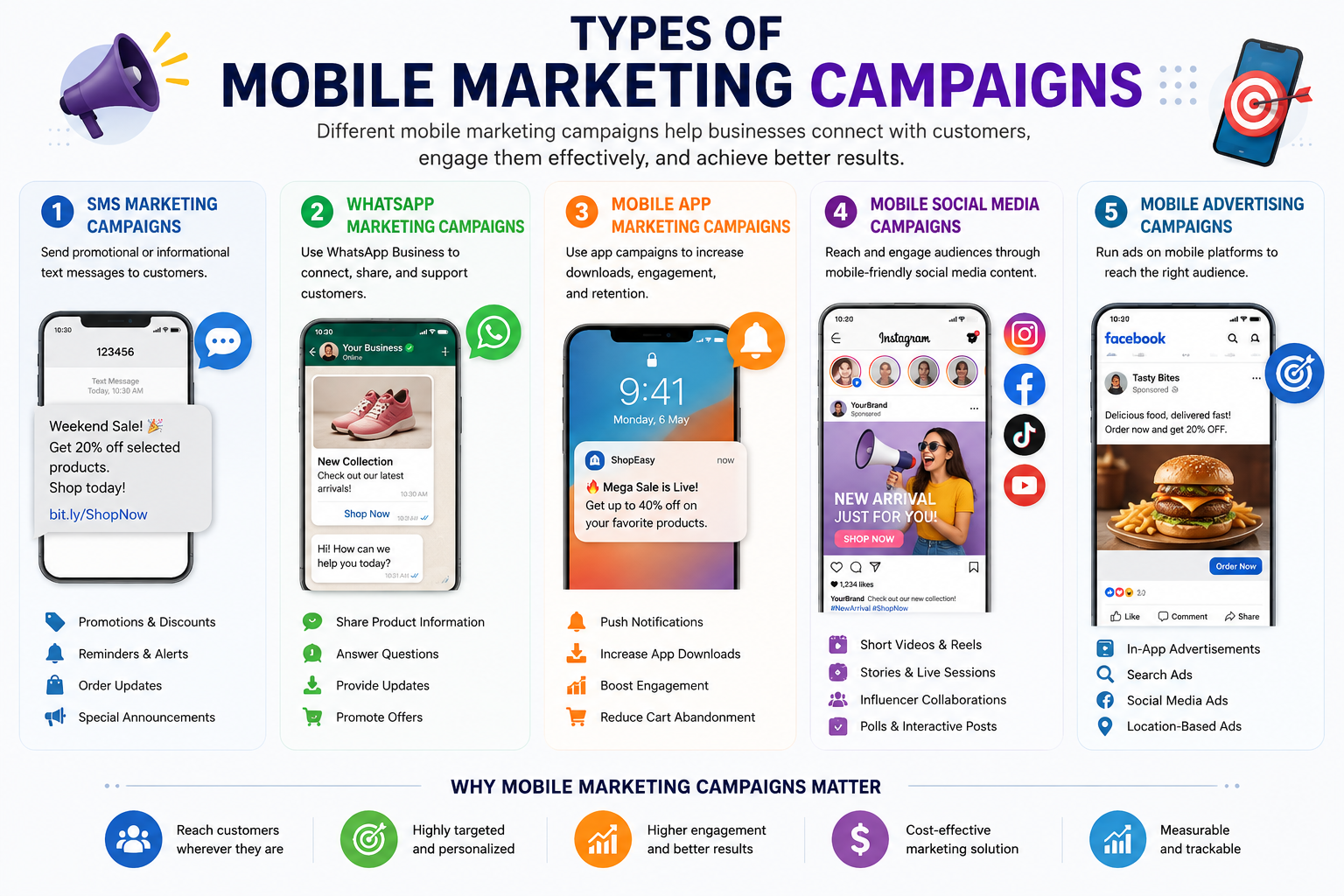
Businesses can use different types of mobile marketing campaigns depending on their goals and target audience.
1. SMS Marketing Campaigns
SMS marketing involves sending promotional or informational text messages to customers. It can be used for product promotions, discounts, reminders, order updates, and special announcements.
For example:
“Weekend Sale! Get 20% off selected products. Shop today.”
SMS messages are usually short and should include a clear call-to-action. Businesses should avoid sending excessive messages and should communicate only with customers who have provided appropriate consent.
2. WhatsApp Marketing Campaigns
WhatsApp has become an important communication channel for businesses. Companies can use WhatsApp Business to communicate with customers, share product information, answer questions, provide updates, and promote offers.
3. Mobile App Marketing Campaigns
Businesses with mobile applications can use app marketing campaigns to increase downloads, engagement, and retention.
Push notifications are one of the most common methods. An e-commerce application, for example, may notify users about a sale, a new product, or an abandoned shopping cart.
However, businesses should avoid sending too many notifications because excessive notifications can cause users to disable them or uninstall the application.
4. Mobile Social Media Campaigns
A large amount of social media activity takes place on mobile devices. Platforms such as Instagram, Facebook, YouTube, and TikTok allow businesses to reach audiences through mobile-friendly content.
Short-form videos, Reels, Stories, influencer collaborations, polls, and interactive posts can all be used as part of mobile social media campaigns.
The content should be visually appealing and optimized for vertical mobile screens.
5. Mobile Advertising Campaigns
Mobile advertising includes advertisements shown on mobile websites, applications, search engines, and social media platforms.
Businesses can use targeting options such as demographics, interests, location, and online behavior to reach relevant audiences.
For example, a local restaurant could use location-based mobile advertising to reach people in a specific area.
How to Create Successful Mobile Marketing Campaigns
A successful mobile marketing campaign requires more than simply sending promotional messages. Businesses should develop a clear strategy before launching the campaign. A well-planned mobile marketing strategy helps businesses reach the right audience, choose suitable channels, deliver relevant content, and measure campaign performance effectively.
Step 1: Define Your Marketing Goal
The first step in creating a successful mobile marketing campaign is to establish a clear objective. Having a specific goal helps marketers decide what type of content and mobile channel should be used.
Your goal could be:
Increasing product sales
Generating leads
Increasing website traffic
Promoting an application
Increasing brand awareness
Improving customer engagement
Increasing repeat purchases
A clear objective makes it easier to measure the performance of your mobile marketing campaign and determine whether the campaign has achieved its intended results.
Step 2: Identify Your Target Audience
Understanding your audience is essential for creating an effective mobile marketing campaign. Marketers should consider customer demographics, interests, location, purchasing behavior, and communication preferences.
For example, a fashion brand targeting young customers may focus heavily on Instagram Reels and mobile video advertising, while a local service business may benefit from WhatsApp communication and location-based advertising.
Understanding the target audience also helps businesses create personalized messages that are more relevant to potential customers.
Step 3: Select the Right Mobile Channel
Not every channel is suitable for every mobile marketing campaign. Businesses should select channels based on their target audience, campaign objective, and type of content.
SMS may be useful for quick promotional messages, while Instagram may be better for visual campaigns. Push notifications can work well for app users, and WhatsApp can be useful for direct customer communication.
Choose channels based on your audience and campaign objective rather than trying to use every platform. Selecting the right channel can help improve engagement and make the campaign more effective.
Step 4: Create Mobile-Friendly Content
Mobile users generally prefer content that is easy to understand and interact with quickly. Therefore, every mobile marketing campaign should provide content that is optimized for smartphones.
Make sure your content has:
Short and clear messages
Easy-to-read text
High-quality visuals
Fast-loading pages
Clear calls-to-action
Mobile-friendly landing pages
For example, instead of using a long message, a business can communicate the main offer in a few sentences and provide a clear “Shop Now” button.
Mobile-friendly content can make it easier for customers to understand the message and take the desired action.
Step 5: Personalize Your Campaign
Personalization can make a mobile marketing campaign more relevant and engaging. Businesses can personalize campaigns based on customer names, previous purchases, interests, location, browsing behavior, or preferences.
For example, instead of sending the same message to every customer, an e-commerce brand could recommend products related to products a customer has previously viewed.
Personalized mobile marketing campaigns can help businesses provide more relevant experiences and improve customer engagement.
Step 6: Choose the Right Timing
Timing can significantly influence the performance of a mobile marketing campaign. Sending messages at inappropriate times may annoy customers and reduce engagement.
Businesses should understand when their target audience is most likely to be active. Marketers can also test different times and compare performance to identify the most effective timing.
Choosing the right time can help ensure that promotional messages, reminders, offers, and notifications reach customers when they are most likely to respond.
Step 7: Include a Strong Call-to-Action
Every mobile marketing campaign should encourage customers to take a specific action. A clear call-to-action tells users exactly what they should do after viewing the message or advertisement.
Examples include:
Shop Now
Learn More
Download the App
Book Now
Get the Offer
Contact Us
Sign Up
A clear call-to-action helps customers understand what they should do next and can encourage more clicks, conversions, and engagement.
Step 8: Track and Analyze Results
After launching a mobile marketing campaign, marketers should analyze its performance to understand what is working and what needs improvement.
Important metrics include:
Click-through rate
Conversion rate
Engagement rate
Open rate
App downloads
Website traffic
Customer acquisition cost
Return on investment
Analyzing these metrics helps marketers identify successful campaigns and areas that need improvement. Businesses can use these insights to optimize future mobile marketing campaigns, improve customer engagement, and achieve better marketing results.
By following these steps, businesses can create a more effective mobile marketing campaign that reaches the right audience, delivers relevant content, and encourages customers to take action.
Test Different Campaigns
A/B testing can help marketers compare different headlines, images, messages, calls-to-action, and landing pages.
For example, a business can test two different SMS messages and determine which one generates more clicks or conversions.
Respect Privacy and Consent
Best Practices for Mobile Marketing Campaigns
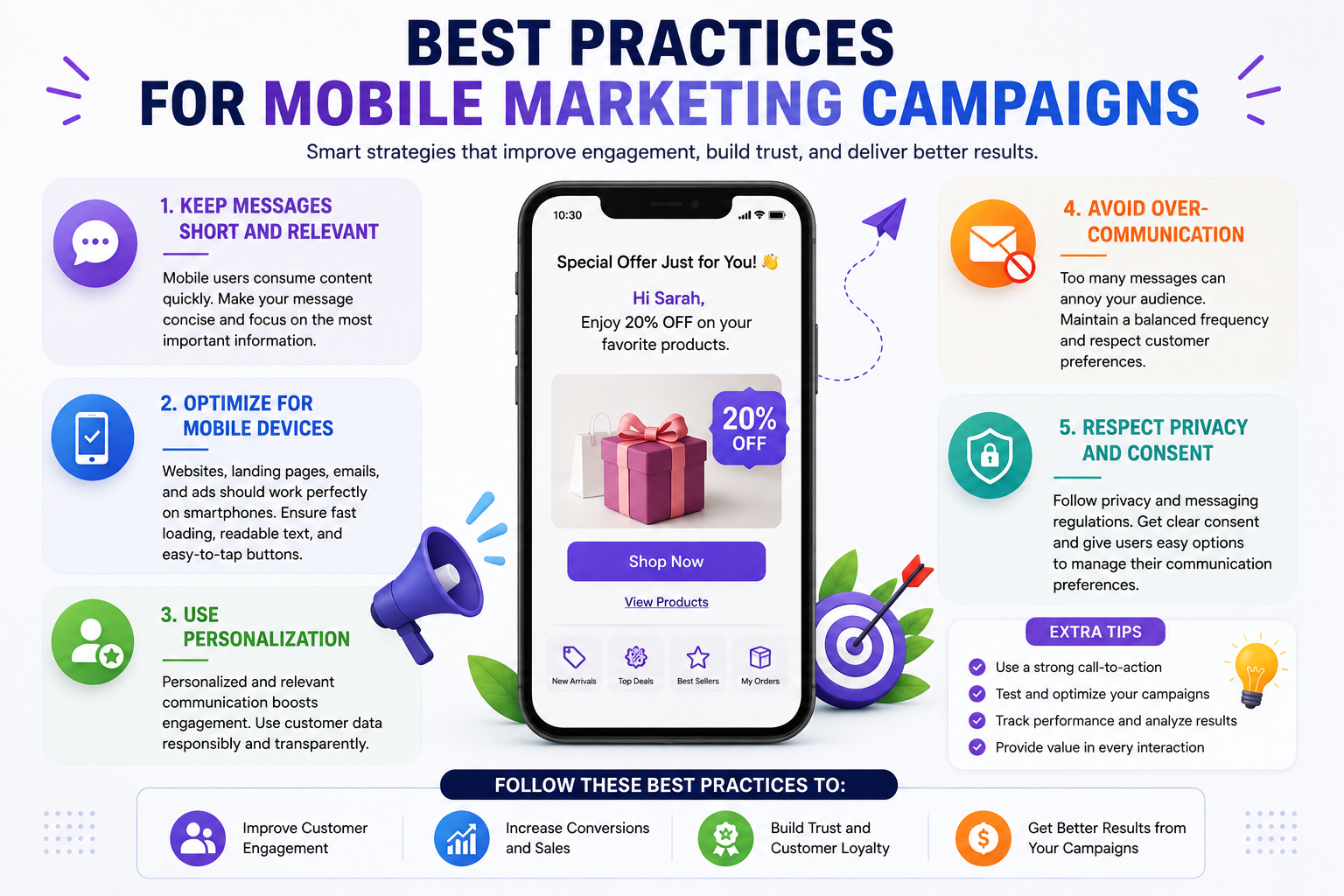
Following best practices can help businesses create more effective campaigns.
Keep Messages Short and Relevant
Mobile users often consume content quickly. Make your message concise and focus on the most important information.
Optimize for Mobile Devices
Websites, landing pages, emails, and advertisements should work properly on smartphones. Buttons should be easy to tap, text should be readable, and pages should load quickly.
Use Personalization
Relevant and personalized communication can improve customer engagement. However, businesses should use customer data responsibly and transparently.
Avoid Over-Communication
Sending too many messages can frustrate customers. Businesses should maintain a reasonable communication frequency and respect customer preferences.
Businesses should follow applicable privacy and messaging regulations. Customers should understand what they are signing up for and should have appropriate options to manage their communication preferences.
Common Mobile Marketing Mistakes to Avoid
Even a well-designed campaign can fail because of simple mistakes.
One common mistake is sending irrelevant messages to customers. If customers repeatedly receive offers that do not match their interests, they may stop engaging with the brand.
Another mistake is creating websites or landing pages that are difficult to use on smartphones. A customer may click an advertisement but leave the website if the page loads slowly or is difficult to navigate.
Businesses should also avoid sending too many notifications or promotional messages. Excessive communication can negatively affect the customer experience.
Failing to track campaign performance is another major mistake. Without analytics, marketers cannot understand which campaigns are successful or where improvements are needed.
The Future of Mobile Marketing
Mobile marketing is continuously evolving as technology and consumer behavior change. Artificial intelligence, automation, personalization, mobile commerce, short-form video, and conversational marketing are becoming increasingly important. These technologies are also helping businesses create more effective mobile marketing campaigns that can reach customers with relevant and timely content.
AI can help marketers analyze customer behavior, create content, personalize communication, and automate certain marketing activities. Businesses can also use automation to send relevant messages based on customer actions. By using AI and automation, marketers can improve the performance of a mobile marketing campaign, identify customer preferences, and deliver personalized offers at the right time.
Mobile commerce is another important area. As more consumers use smartphones to discover and purchase products, businesses need to provide simple and convenient mobile shopping experiences. Mobile marketing campaigns can support this growth by directing customers to mobile-friendly websites, product pages, apps, and online stores, making the purchasing process faster and easier.
Short-form videos, social media content, push notifications, SMS, and messaging platforms are also expected to play an important role in future mobile marketing campaigns. Businesses can use these channels to engage customers, promote products, share offers, and build stronger relationships with their target audience.
The future of mobile marketing will likely focus on delivering more personalized, useful, and timely experiences while maintaining customer trust and privacy. Businesses that create well-planned mobile marketing campaigns and adapt to changing mobile technologies can improve customer engagement, generate leads, increase conversions, and achieve better marketing results.
Conclusion
Mobile marketing campaigns have become an important part of modern digital marketing. They allow businesses to connect with customers through smartphones using SMS, WhatsApp, mobile apps, social media, push notifications, and mobile advertising. As more people use smartphones for communication, shopping, entertainment, and online activities, mobile marketing campaigns provide businesses with valuable opportunities to reach and engage their target audience.
A successful mobile marketing campaign begins with a clear marketing objective and a well-defined target audience. Businesses then need to select the appropriate mobile channel, create engaging mobile-friendly content, personalize communication, choose suitable timing, and track campaign performance. A well-planned mobile marketing strategy can help businesses deliver the right message to the right audience at the right time.
Personalization and relevant content are also important for improving mobile customer engagement. Businesses can use customer preferences, previous interactions, browsing behavior, and purchasing history to create more meaningful communication. SMS marketing, WhatsApp marketing, push notifications, social media marketing, and mobile advertising can all be used as part of an effective mobile marketing campaign.
As smartphone usage and mobile commerce continue to grow, businesses that invest in effective mobile marketing campaigns can create stronger customer relationships, increase engagement, generate leads, improve conversions, and drive sales. Tracking important metrics such as click-through rates, conversion rates, engagement, website traffic, and return on investment can also help businesses improve future campaigns.
The key is not simply to reach customers on their mobile devices, but to provide them with relevant, valuable, and timely experiences that encourage them to engage with the brand. By combining the right mobile channels, personalized content, strong calls-to-action, and data-driven optimization, businesses can create successful mobile marketing campaigns and achieve long-term digital marketing growth.